


Sales route optimization change management is the operational strategy of driving field sales software adoption by aligning route planning tools with seller psychology. Effective change management eliminates rep resistance by automating administrative workloads, establishing peer-led pilot programs, and using drive-time workload metrics to balance territories fairly.
You spend months evaluating platforms, securing executive budget, and deploying a sales routing tool, only to watch adoption stall. Instead of eager enthusiasm, sales operations leaders hit a predictable wall of resistance: reps push back, accuse leadership of corporate micromanagement, and let high-value software sit underutilized as shelfware.
Most field sales technology rollouts fail because they treat human sellers like logistics problems to be solved. When sales leaders introduce route optimization as a top-down mandate, representatives perceive it as a time-consuming administrative burden dumped onto an already overloaded schedule.
Field reps are already swamped from dawn to dusk, so adding a new app feels like extra work for zero personal payoff. To achieve genuine, team-wide adoption, sales operations leaders must stop pitching corporate efficiency and start tapping into the core motivation of the field seller. Sellers do not stay in field sales because they enjoy spreadsheets, route mapping, or administrative tracking—they do it because they love to sell. Route optimization must be positioned as a rep-empowering tool that actively reclaims wasted miles and transforms them into pure, uninterrupted selling time.
Gleicher’s Formula for Change (D times V times F > R) proves that overcoming rep resistance (R) requires
- Dissatisfaction (D) with non-selling travel time
- Establishing a vision (V) of reclaimed selling hours
- Executing low-friction first steps (F) through peer-led pilots
Think of it this way. If you don’t have a level of dissatisfaction high enough combined with a vision of what success could like like, using route optimization software, your team won’t take the first steps. Therefore you’ll never overcome resistance to change.
When field reps push back against new software, sales leaders often assume reps are simply resisting progress. In reality, sellers are protecting their limited hours from what feels like another time-consuming administrative penalty added to an already packed schedule. To break this cycle, sales operations leaders can apply Gleicher’s Formula for Change:
Dissatisfaction (D) X Vision (V) X First Steps (F) > Resistance (R)
Dissatisfaction (D) is built by validating the rep's daily reality rather than lecturing them on flawed habits. Industry benchmarks reveal that field sellers spend only 28% of their working hours actually selling, while 72% gets swallowed by windshield time, traffic, and administrative drag.
Many of your team are fed up with the admin, so you are pushing an open door, but you’ll need so combine that will a vision of success. Reclaiming 20% to 30% of lost drive time provides the compelling Vision (V) sellers need, converting reclaimed travel into 3.5+ additional face-to-face customer meetings every week.
When sales ops pair this vision with a pilot scheme in which they work with known champions or early adopters, to “road test” and prove the value. Then that all important First Step (F), is initiated. By getting those “champions” to use and prove value you can get to that magical 25% adoption rate which is a proven inflection point for team wide adoption. We learn great behaviors from others, not the manuals. This is the path to reducing team resistance (R) giving a way to genuine software adoption.
Reframing route optimization around "What’s In It For Me?" (WIIFM) shifts software perception from corporate tracking to rep empowerment. Showing reps how automated route sequencing converts wasted miles into reclaimed selling time allows field sellers to close more deals without working longer hours.
Once reps realize route optimization exists to strip away non-selling noise, the "What’s In It For Me?" framing becomes immediately clear. Field sellers tolerate non-selling administrative tasks because they accept them as necessary evils, but they thrive on the high of closing deals.
Every single mile taken back from unnecessary backtracking or poor route sequencing is a mile returned to active selling. By framing software around reclaimed customer time, the value proposition shifts from executive monitoring to individual rep empowerment. eSpatial dynamic mobile routing automates multi-stop route sequencing, eliminating manual morning schedule planning and unnecessary driving loops. Cutting out inefficient travel loops returns hours of lost drive time directly to the seller's weekly calendar.
Reclaimed drive time translates into more face-to-face customer conversations—the exact part of the job that energizes reps and drives commission. Fitting even one extra quality touchpoint into a daily schedule compounds into substantial pipeline velocity over a sales year. Route optimization stops feeling like an administrative burden and starts feeling like an unfair competitive advantage.
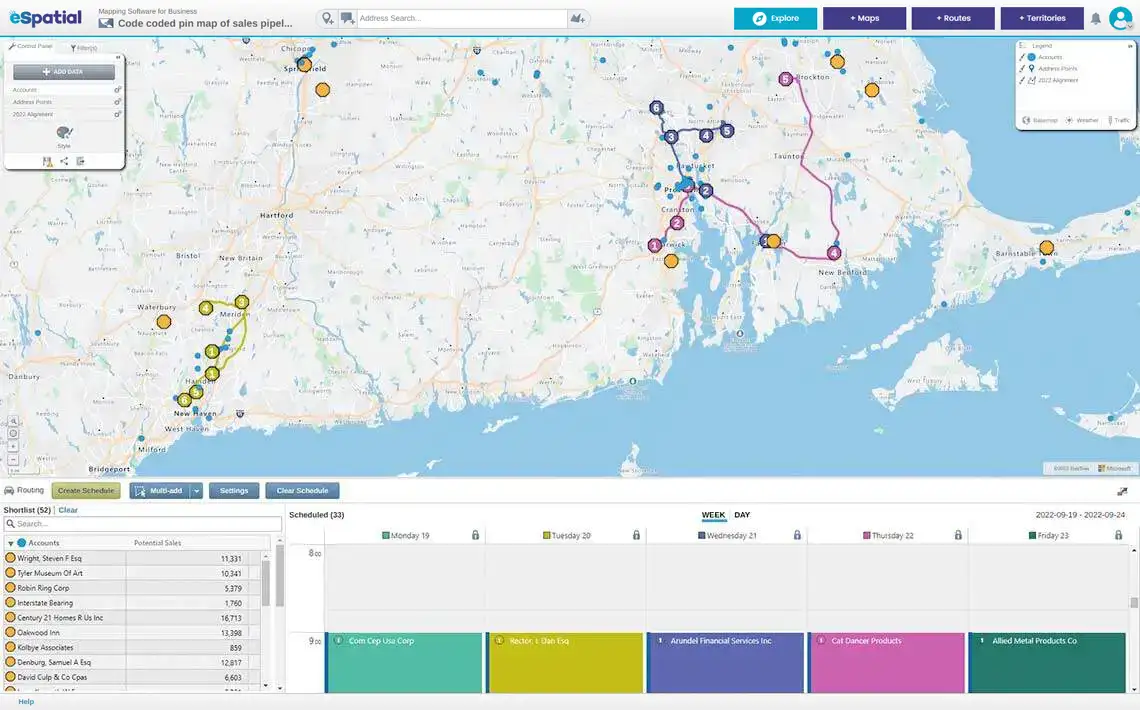

Mobile CRM synchronization eliminates late-night data entry by allowing sellers to log meeting outcomes, enter quick notes, and update accounts directly from their mobile map in 30 seconds. Bidirectional synchronization instantly updates systems like Salesforce, finishing administrative work in the field.
Nothing kills a field rep's momentum faster than administrative fatigue after a long day on the road. While sellers tolerate in-person customer challenges, sitting in front of a laptop at 8 PM to manually re-enter notes into a CRM creates deep friction. Modern sales route optimization eliminates this evening administrative drag through mobile-first CRM integration. Before stepping into a meeting, reps view complete account histories, contact details, and deal stages directly on their interactive mobile map.
Immediately after wrapping up a visit, reps log meeting outcomes, complete quick mobile check-in fields, and set follow-up tasks in minutes. Live bidirectional synchronization updates Salesforce automatically in real time. Field sellers complete their daily paperwork on site, ensuring that when they pull into their driveway at 5 PM, their workday is completely done.
Sales managers handle territory realignment pushback by using a transparent Workload Index equation to equalize workloads. The Fairness Defense script proves territory boundaries are rebalanced using actual travel hours and visit durations rather than raw account counts.
Territory rebalancing routinely triggers anxiety because sellers worry about losing key accounts or getting stuck with sprawling, difficult travel zones. This pushback stems from the Equal Call Fallacy—assigning equal account counts to every rep without factoring in geographic drive times or meeting durations.
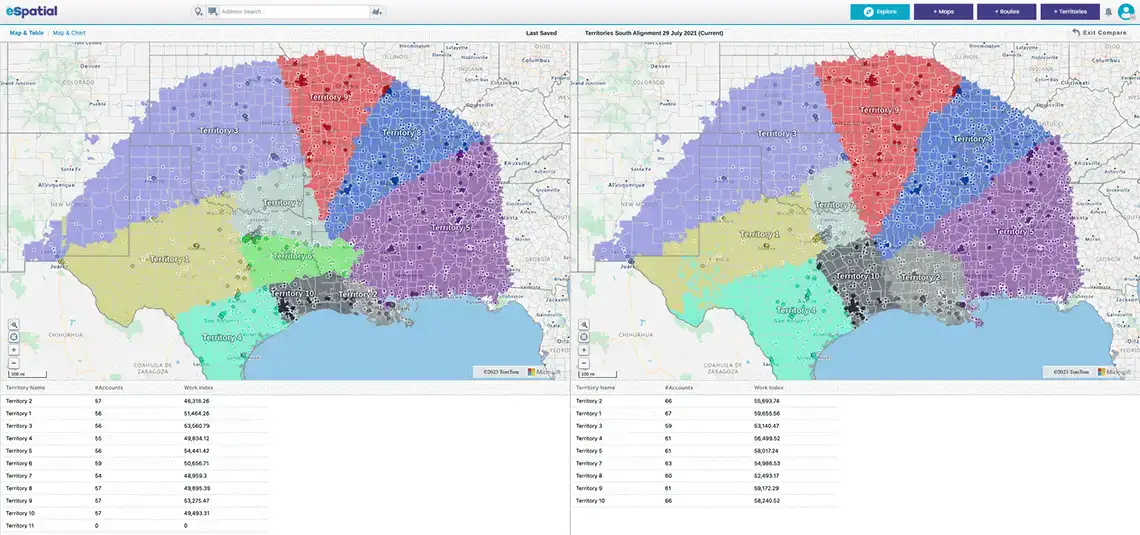
eSpatial Isochronal Drive-Time Buffers evaluate boundaries using real-world road networks and travel patterns rather than basic straight-line radius circles. This ensures every representative receives a balanced territory designed around manageable work hours.
The Workload Index equation calculates total workload by adding combined meeting durations to total travel time:
Workload Index = (Call Frequency X Duration) + Drive Time
This ensures every sales patch is balanced fairly based on real work hours rather than raw account numbers. To neutralize resistance, managers use a transparent Workload Index formula during 1-on-1 alignment reviews. Sales leaders can use this plug-and-play communication script during territory reviews:
"We aren't splitting areas by raw customer counts on a spreadsheet anymore, because ten visits across a spread-out region takes twice as much energy as ten visits in a dense cluster. We evaluated our territories using a Workload Index that factors in actual drive times, meeting durations, and visit frequencies. This alignment balances real work hours across the team, cuts out wasted windshield time, and ensures you aren't spending hours stuck in traffic while someone else has a 10-minute drive. This isn't about taking accounts away, it's about protecting your time so every mile you drive gives you a fair shot at hitting your number."
Sales managers handle common route optimization objections by addressing underlying rep fears directly. Framing tools around automated admin relief, drive-time buffers, and account priority ensures reps maintain daily autonomy while maximizing earning potential.
|
Rep Objection |
Underlying Fear |
Recommended Response |
|---|---|---|
|
"You're just giving me another administrative task to track my day." |
Loss of autonomy & extra work. |
"This isn't an extra task—it's an automated tool designed to eliminate the manual route planning and late-night logging you're already doing. You keep full control over your day." |
|
"My territory is too spread out to make this worth it." |
Unrealistic expectations & burnout. |
"That's exactly why we rebalanced your boundary using drive-time buffers. Eliminating useless travel loops reduces your total mileage, taking the stress out of covering your patch." |
|
"I already know my roads better than a computer." |
Skepticism of generic mapping tools. |
"Consumer GPS tools only know basic traffic—they don't know your deal priorities or client availability. This tool locks in your key appointments first, so your drive time is spent reaching high-value accounts." |
A 16-week route optimization roadmap transitions field sales teams through four structured phases: launching a 25% pilot group, framing seller benefits, eliminating evening administrative logging, and executing fair territory realignments using drive-time workload metrics.
Implementing change across a field sales organization requires a structured, phased approach rather than an overnight mandate. Structuring software deployment across four targeted months builds momentum, creates social proof, and neutralizes rep resistance at every phase:
|
Timeline |
Focus Area |
Core Action Items & Deliverables |
|---|---|---|
|
Month 1 |
The 25% Pilot |
Partner with 2–3 influential, respected field reps. Run a quiet pilot focused on capturing seller proof: drive time saved and evening admin eliminated. |
|
Month 2 |
The "WIIFM" Launch |
Hold a team launch led by your pilot champions. Frame the tool around taking back miles to spend more time selling, and directly address "extra task" concerns. |
|
Month 3 |
Admin Elimination |
Roll out native mobile check-in tools and Salesforce CRM integration. Show reps how 30-second curb check-ins eliminate 8 PM data entry completely. |
|
Month 4 |
Territory Realignment |
Roll out balanced territory boundaries using the Workload Index and eSpatial scenario planning. Conduct 1-on-1 reviews using the Fairness Defense Script to show reps how workloads have been equalized. |
By respecting seller psychology, eliminating administrative friction, and leveraging peer influencers to cross the 25% tipping point, sales operations leaders transform route optimization from an unwelcome mandate into an essential selling tool.