

Quick answer
Assigning 15 delivery stops to Driver A and 15 stops to Driver B inside a delivery boundary looks balanced on a spreadsheet, right up until Driver B spends six hours backtracking through heavy traffic while Driver A wraps up by early afternoon.
In daily distribution and field delivery operations, forcing static stop counts or rigid schedules onto unpredictable road networks creates massive operational friction.
When routes are generated day by day based on incoming orders and tight client delivery windows, spreadsheet-based planning breaks down, exposing fleet operations to missed SLAs, runaway fuel costs, and driver burnout.
To keep delivery boundaries balanced and fleets efficient, operations leaders must replace spreadsheet-based guessing with dynamic day-trip planning.
How Spreadsheet Route Planning
Causes SLA Breaches
Spreadsheet planning relies on static order counts while ignoring road networks, travel backtracking, traffic bottlenecks, and sudden mid-day pickups.
This creates severe workload imbalances where one driver operates in a tight, hyper-efficient drop zone while another spends hours stuck in windshield time—resulting in missed delivery windows and inflated fleet expenses.
The Flaw of "15 Drops = 15 Drops" Logic
Dividing daily delivery orders equally among drivers inside a static zone sounds fair on paper, but it treats physical geography as a flat grid. A five-mile dense commercial drop zone can take twice as long to navigate during morning hours as twenty miles of open highway stops.
Furthermore, spreadsheet grids cannot account for order drop complexity, loading times, or strict client delivery windows. When order density fluctuates, dispatchers spend their mornings playing air-traffic controller, manually moving stops between sheets and sending drivers way outside their primary delivery boundaries.
The Cost of Unmapped Travel Backtracking
Windshield time is the single largest hidden drain on fleet profitability. When delivery boundaries are drawn using static postal codes or straight-line radii rather than true road-network drive times, drivers routinely cross paths on the highway.
This unnecessary travel inflates fuel budgets and accelerates vehicle wear across your fleet. More critically, every extra hour spent behind the wheel reduces daily delivery capacity and risks costly SLA contract penalties.
Legacy Spreadsheet Planning vs. Dynamic Day-Trip Optimization
|
Performance Metric |
Legacy Spreadsheet Planning |
Dynamic Day-Trip Optimization |
|---|---|---|
|
Daily Windshield Time |
Unpredictable; spikes during high-density order days due to static boundaries |
Minimized and bounded; constrained by optimized road-network drive buffers |
|
SLA & Delivery Compliance |
Reactive; vulnerable to travel delays and poor stop sequencing |
Proactive; protected by realistic travel buffers and drop-window constraints |
|
Driver Workload Parity |
Low; high-density drop zones overwhelm drivers while low-density zones sit idle |
High; day trips reflect actual travel time, order complexity, and stop density |
|
Mid-Day Order Additions |
Forces manual cross-boundary dispatching and route backtracking |
Re-sequenced dynamically on the fly without breaking downstream delivery windows |
The Day-Trip Optimization Framework
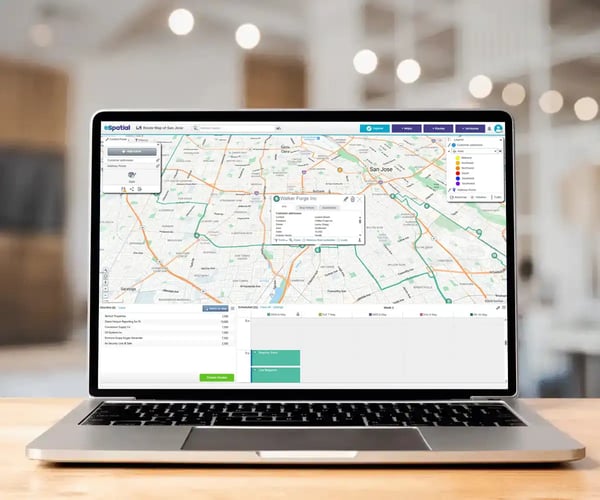
Balancing daily deliveries across regional teams requires evaluating order density, delivery time windows, and road network travel times simultaneously. Instead of forcing static daily schedules, operations leaders use software to run automated day-trip planning inside established delivery boundaries.
Ingestion
Daily Orders Ingested into Regional Delivery Boundaries.
Constraint Mapping
Match Drop Windows, Vehicle Capacity & Driver Skills.
Spatial Optimization
eSpatial Engine Calculates Multi-Stop Day Trips.
Execution
Drivers Receive Sequence-Optimized Day Trips on the Road.
Deconstructing the Day-Trip
Optimization Inputs
To convert daily order volume into predictable drop schedules, the day-trip planning engine balances four key operational variables:
Delivery
Boundary Patches
Regional coverage zones that anchor drivers to logical geographic hubs without trapping them in rigid, unyielding borders.
Order Time
Windows & SLAs
Strict client arrival constraints that dictate exact delivery sequences.
Vehicle &
Cargo Capacity
Weight, volume, or equipment limits mapped directly to driver assignments.
Road-Network
Drive Times
Precise transit calculations between multi-stop drops based on actual road networks rather than straight lines.
Ingesting these variables directly into day-trip planning software takes seconds. It instantly eliminates route backtracking and ensures every driver carries a realistic, achievable daily route.
Mid-Day Agility: Handling Depot
Pickups, Priority Drops, and Exceptions
Macro delivery boundaries provide structural balance, but daily operations require mid-day agility. Dispatchers must handle emergency SLA orders, specialized parts depot runs, and hot-shot deliveries without derailing the rest of the fleet's daily schedule.
Balancing Boundary Structure
with Dynamic Route Agility
Rigid delivery boundaries force dispatchers into a bad choice: adhere strictly to assigned zones and miss urgent orders, or break boundary lines completely and cause massive travel backtracking.
Establishing clear delivery boundaries ensures baseline fleet organization. Combining those boundaries with dynamic day-trip planning allows dispatchers to handle daily chaos effortlessly. If Driver A faces a sudden spike in priority orders, a dispatcher can dynamically assign an overflow drop to Driver B based on real-time drive-time proximity—without permanently disrupting delivery zones.
The Mid-Day Depot
Re-Optimization Protocol
When an urgent SLA order requires an unplanned detour to a central parts depot, dispatchers run a structured four-step re-optimization process:
Trigger Event
Dispatcher receives an emergency order requiring immediate pickup at a central distribution hub or parts depot.
Drive-Time Radius Check
Use mapping software to locate available drivers operating within an acceptable drive-time radius of the depot.
Route Re-Sequence
Insert the depot stop directly into the selected driver's active day trip, automatically recalculating the remaining drop order.
SLA Breach Guard
Verify that updated downstream drop arrival times still meet client SLA windows before dispatching the update.
Proving Operational Impact
to Leadership and Fleet Drivers
Rebalancing delivery boundaries and changing route processes creates friction. Executive leadership demands clear return on investment (ROI), while experienced drivers often resist changes to their familiar daily drop sequences. Overcoming this friction requires transparent data and clear operational communication.
Securing Executive Alignment
Operations directors, like Tina, prove operational efficiency to executive leadership by connecting day-trip optimization directly to high-level corporate KPIs:
30% reduction in
fleet windshield
time & fuel burn
By eliminating cross-boundary route backtracking.
20% increase
in daily delivery
capacity
Without hiring additional drivers or adding fleet vehicles.
Elimination of
SLA penalty fees
Caused by travel delays and manual spreadsheet dispatching bottlenecks.
Neutralizing Driver Pushback:
The "Fairness Defense"
Experienced delivery drivers guard their familiar routes fiercely. Reassigning delivery stops or shifting drop zones based on dispatcher intuition can feel arbitrary or biased.
Presenting objective day-trip data shifts the conversation from personal bias to transparent math. Show drivers that optimized day trips are designed to eliminate painful traffic drag and protect their end-of-day wrap-up times.
We aren't splitting routes by simple stop counts on a spreadsheet anymore, we’re evaluating total daily workload impact. By combining actual drive times, order drop complexity, and delivery windows, this new day-trip planner balances real work hours across the fleet, cuts unnecessary windshield time, and ensures you aren't stuck in traffic trying to hit late-afternoon delivery windows.
Stop Relying on Spreadsheets for Your Delivery Boundaries
Legacy spreadsheet planning ignores real road networks, leading to severe travel backtracking, inflated fuel budgets, and costly SLA breaches. Transition to dynamic day-trip optimization to balance driver workloads, minimize windshield time, and seamlessly handle mid-day emergency orders
No credit card required